
Tuesday, February 7, 2012

Monday, February 6, 2012
Extra Gaits of the Horse (probably works for mules also)
--The Boink
One-beat gait with suspension, often exhibited by horses ridden into a
field of white-tailed deer.
--The Lateral Swoop
A sudden sideways leap with shoulder horizontal to the ground, leaving
the rider hovering briefly over where the saddle used to be before
descending to the ground. Can be precipitated by a tractor starting up
outside the arena, snow sliding off the arena roof, a large rock that
magically turns into a bear or a green plastic garbage bag.
--The Whirling Dervish
Advanced version of the Lateral Swoop in which the horse spins like a
top, frequently launching the hapless rider a long distance by
centrifugal force. Specialty of certain Arabians, often caused by
viewing a 4-wheeler approaching on the trail ahead.
--The Yahooey
One of the natural Airs Above the Ground, a highly suspended movement
exhibited when turned out or during the first canter in an open field.
A variation is the Jet-Assisted Buck & Fart, in which the horse
achieves maximum height and momentum aided by the loud expulsion of
exhaust gas. Occurs on cold, windy days when the wind goes up the
horse's tail and blows his brains out his ears.
--The Omigod
Sudden backwards movement accompanied by loud, rolling snorts, ears
stiffly forward and eyes bugging out, exhibited by a horse that has
spotted a monster (invisible to the human eye) advancing on him from
the front. Can be precipitated in visible form by riding up to a large
blue tarp, which the wind then moves slightly.
--The Hot Wheels
Speed gait in which all four legs rotate at high speed, often leaving
rubber strips on the ground. Frequently exhibited by runaway ponies,
rushing jumpers and horses returning to the barn.
--The Shark Circling the Rowboat
Characteristic movement of lesson horse in ever-decreasing concentric
circles around the instructor, until the horse is in the center
standing on the instructor's left foot and further progress is
impossible. (Old school horses tell new school horses how to do this.)
--The Sloth
Typical gait of school horse who has perfected the art of laziness. No
perceptible forward movement, in spite of encouraging kicks, clucks,
flapping reins, ineffective crop swats, shouts and jumping up and
down. (Note: the Sloth can be transformed into Hot Wheels by the sight
of the instructor advancing with lunge whip in hand.)
--The Flapper
Movement in which the horse shakes like a wet dog, totally terrifying
the beginner rider. Horse then grins an evil grin and eats grass.
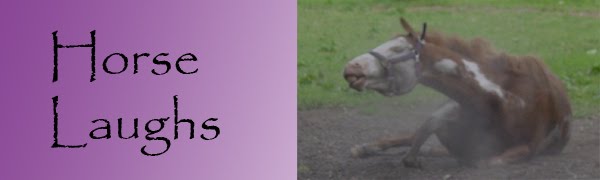
--The Wallow
Rotational movement performed on the ground, especially in mud, sand
or water. Always performed when the instructor is at the other end of
the trail ride or not looking.
--Followed by the Upsie Daisy
Which always occurs before the arrival of the instructor. Horse
perfects the Wallow by rolling in mud, sand or water, usually defiling
the purity of the perfectly clean saddle regardless of screams.
--The Snail Rocket
The two walking gaits of experienced trail horses on the trail. Going
out, the walk is so snail-like, time perceptibly slows. Coming back,
trotting horses can barely keep up with the rocket walk. Essentially,
horses perfectly understand physical law; the speed of the walk is
directly proportional to the direction on the trail.
--The Bobber
Gait which old experienced trail horses proceed with child or beginner
on back. Walk a few feet, stop, horse pulls reins through hands of
beginning rider and eats grass. Repeat 50 times.
Friday, June 17, 2011

Thursday, June 16, 2011

Wednesday, June 8, 2011
Friday, May 27, 2011
Rules of dressage
1. If you really want to get better at dressage, take it up at an earlier age – and grow an extra 3 inches of leg.
2. A test that starts with an arrow straight centre line and a square halt signifies the start of a Hickstead Speed derby.
3. A dressage test is a test of your skill against another competitor’s luck.
4. Dressage is about achieving a harmonious working relationship with your horse, whose only idea of harmony is eating grass in a field with his buddies.
5. If you want to end a drought or dry spell, wear a new jacket and Patey hat to an outdoor arena.
6. Untalented, difficult, aggressive horses have robust health, good hocks and long lives.
7. Talented tractable horses are accident prone and have OCD lesions.
8. You will ride the best test of your entire life just prior to being disqualified for not wearing your gloves.
9. Never keep more than 300 separate thoughts in your head before a test.
10. Never keep less than another 300 separate thoughts in your head during a test.
11. Horses do not improve their paces because you are wearing expensive German breeches.
12. If you chose a disco theme for your dressage to music test then the judge will be more than 90 years of age and Swiss.
13. The less skilled the rider, the more likely they are to share their critique of your test.
14. If you are considering the services of a horse clairvoyant to help you with training then you have reached the point of total desperation – try the German breeches.
15. Your horse has never heard of Podhajsky let alone read the book.
16. No matter how badly you ride a test, it is always possible to ride a worse one.
17. If it ain’t broke, try shifting your position and it will be.
18. Judges only suffer from temporary blindness (or kindness) when they are judging someone else’s test.
20. If you fall off your horse in the arena you will have paid to have the test videoed.
21. If you are feeling confident before a show then three of the British dressage team will turn up to give their young horses some “experience.”
22. Your horse will perform its best piaffe ever when you ask for extended canter.
23. Since runs of bad competitions come in groups of three, the fourth competition is actually the beginning of the next group of three.
24. No one cheats at dressage because no one has worked out how to do it.
25. It is surprisingly easy to end a test with a perfect square halt once you have scored a four for every other movement.
26. The result of an expensive lesson from a top pro is that you will stop believing in that tiny piece of innate ability that was holding your riding together.
27. Remember when buying a dressage horse advertised as “needs experienced competitive rider” this really means “needs the skills of Phillip Dutton just to stay on board.”
28. If you think your test was better than someone elses, it probably wasn’t.
29. If you pay 60,000 for an imported WB, you will be beaten in First Level 4 by a quarter horse.
30. Clinics given by someone with an interesting accent are not necessarily superior to those given by the homeboy.
31. If you go to the expense of raising an expensive WB foal, he will have a talent for jumping and no walk worth talking about.
2. A test that starts with an arrow straight centre line and a square halt signifies the start of a Hickstead Speed derby.
3. A dressage test is a test of your skill against another competitor’s luck.
4. Dressage is about achieving a harmonious working relationship with your horse, whose only idea of harmony is eating grass in a field with his buddies.
5. If you want to end a drought or dry spell, wear a new jacket and Patey hat to an outdoor arena.
6. Untalented, difficult, aggressive horses have robust health, good hocks and long lives.
7. Talented tractable horses are accident prone and have OCD lesions.
8. You will ride the best test of your entire life just prior to being disqualified for not wearing your gloves.
9. Never keep more than 300 separate thoughts in your head before a test.
10. Never keep less than another 300 separate thoughts in your head during a test.
11. Horses do not improve their paces because you are wearing expensive German breeches.
12. If you chose a disco theme for your dressage to music test then the judge will be more than 90 years of age and Swiss.
13. The less skilled the rider, the more likely they are to share their critique of your test.
14. If you are considering the services of a horse clairvoyant to help you with training then you have reached the point of total desperation – try the German breeches.
15. Your horse has never heard of Podhajsky let alone read the book.
16. No matter how badly you ride a test, it is always possible to ride a worse one.
17. If it ain’t broke, try shifting your position and it will be.
18. Judges only suffer from temporary blindness (or kindness) when they are judging someone else’s test.
20. If you fall off your horse in the arena you will have paid to have the test videoed.
21. If you are feeling confident before a show then three of the British dressage team will turn up to give their young horses some “experience.”
22. Your horse will perform its best piaffe ever when you ask for extended canter.
23. Since runs of bad competitions come in groups of three, the fourth competition is actually the beginning of the next group of three.
24. No one cheats at dressage because no one has worked out how to do it.
25. It is surprisingly easy to end a test with a perfect square halt once you have scored a four for every other movement.
26. The result of an expensive lesson from a top pro is that you will stop believing in that tiny piece of innate ability that was holding your riding together.
27. Remember when buying a dressage horse advertised as “needs experienced competitive rider” this really means “needs the skills of Phillip Dutton just to stay on board.”
28. If you think your test was better than someone elses, it probably wasn’t.
29. If you pay 60,000 for an imported WB, you will be beaten in First Level 4 by a quarter horse.
30. Clinics given by someone with an interesting accent are not necessarily superior to those given by the homeboy.
31. If you go to the expense of raising an expensive WB foal, he will have a talent for jumping and no walk worth talking about.
Subscribe to:
Posts (Atom)